Events
Building AI Is No Longer the Hard Part
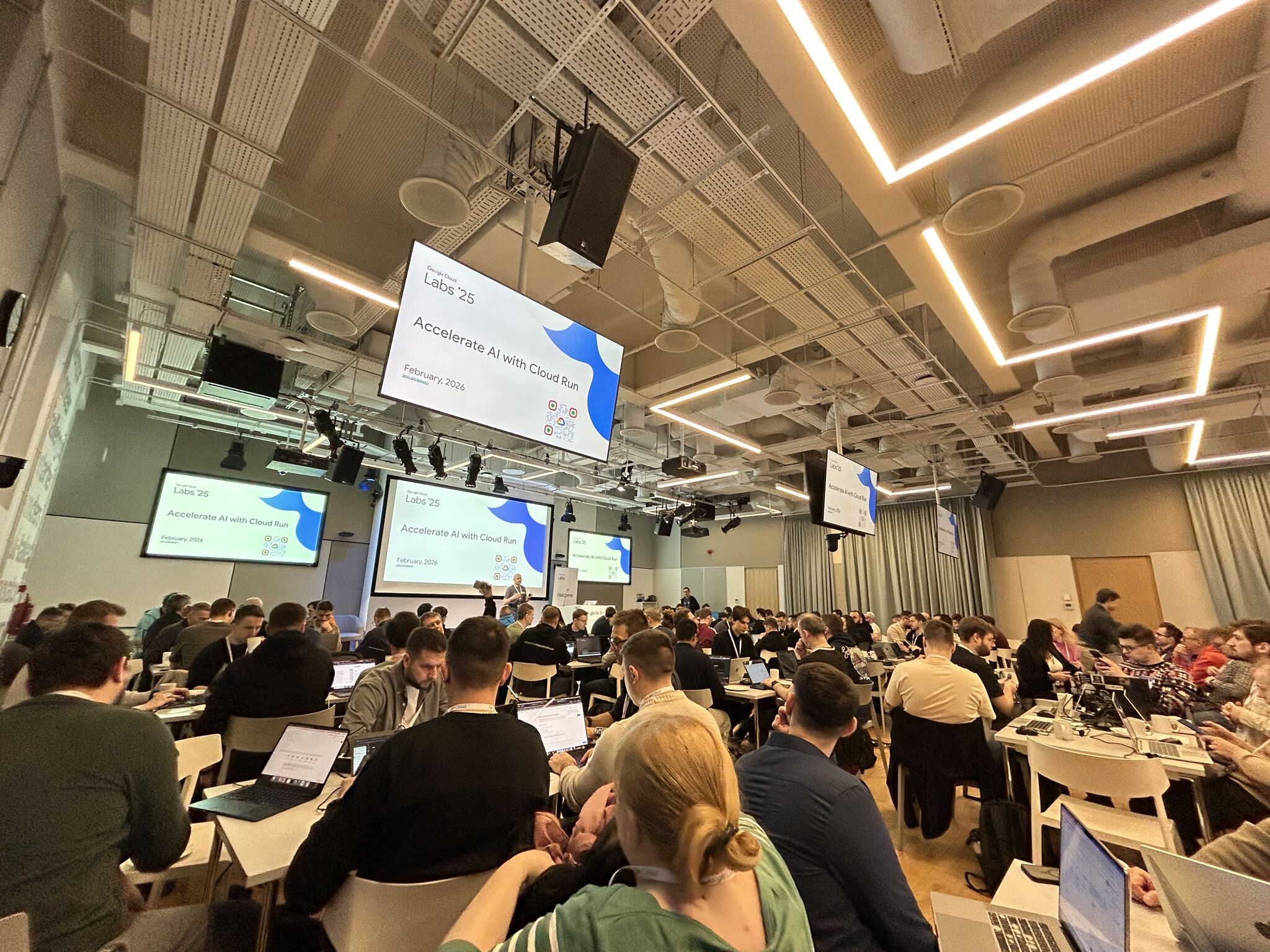
I've just stepped out of the full-day Accelerate AI with Cloud Run workshop at Google for Startups in Warsaw. Over the course of a single day, participants built and deployed multi-component AI agents on production-grade infrastructure — secure MCP servers, intelligent agent logic, GPU-accelerated inference, and serverless deployment — from scratch.
Why Product Clarity — Not Engineering Capacity — Is the Real Bottleneck
Date: 17.02.2026 | Location: Google for Startups, Warsaw | Agenda
We deployed working AI agents on production-grade infrastructure in hours. That's the easy part now. The hard part is knowing whether any of it deserves to exist.
Let me be clear: building serious AI systems is still hard. Security, observability, scaling, cost control, integration — the engineering craft absolutely matters.
But the infrastructure friction that used to gate AI development has collapsed. And that collapse changes what product managers should worry about.
The Infrastructure Shift Is Real
The workshop ran on Google Cloud Run, which reached general availability for NVIDIA GPU support in mid-2025. The platform offers pay-per-second billing, scale-to-zero when idle, and cold starts under five seconds for GPU instances. No reservations. No cluster management. Just containerized code with a GPU flag.
This isn't unique to Google. The serverless GPU market has matured rapidly. Providers across the industry now offer on-demand GPU compute with automatic scaling, sub-second billing, and deployment experiences that abstract away the underlying infrastructure entirely. What used to require a dedicated ML infrastructure team can now be handled by a small product team with cloud credentials.
The Accelerate AI workshops reflect this shift. Google designed them as hands-on build sessions — not lectures — where participants go from zero to deployed agent in a single day. The curriculum covers the full prototype-to-production journey: secure tool servers using the Model Context Protocol, agent orchestration, GPU-accelerated model serving, and production deployment patterns.
The point isn't that infrastructure has become trivial. It hasn't. The point is that the time from idea to working system has compressed from months to hours for a meaningful class of AI applications. And that compression has consequences.
When Infrastructure Friction Drops, Weak Product Thinking Gets Exposed
Andrew Ng put it bluntly: engineers are dramatically faster now, but product managers haven't sped up at the same rate. The bottleneck has shifted.
This observation is gaining traction across the industry. As one product leader at airfocus noted, AI accelerates engineering, coding, and delivery — but the decision-making hasn't caught up. That gap exposes weak strategy and weak product management. Battery Ventures reached a similar conclusion in their analysis of the PM role: engineers can now build and ship features faster than PMs can plan, and in some cases, faster than users can absorb the changes.
The implications are uncomfortable. When building was slow and expensive, mediocre product thinking was hidden by the constraint itself. There was always a backlog. There was always a queue. The bottleneck was engineering capacity, which meant every idea that made it into the pipeline felt valuable simply because it survived the wait.
Now the queue is gone. A startup can go from idea to working prototype in hours. And when you can build anything quickly, the question stops being "Can we build it?" and becomes "Does this deserve to exist?"
That's a product question. And many teams aren't equipped to answer it rigorously.
The Five Questions That Matter Now
For product managers working with AI, the harder questions aren't technical. They're about value, risk, and discipline.
What exact workflow are we improving? Not "making things better with AI" — the specific, observable sequence of steps a user currently performs. If you can't describe the workflow in concrete terms, you don't have a use case. You have a theme.
What's the quantified baseline before AI? How long does the current workflow take? What does it cost? What's the error rate? Without a baseline, you can't measure improvement. And without measured improvement, you can't justify the investment — or know when to stop.
What autonomy level is appropriate? This is one of the most consequential design decisions in AI products. Should the system suggest, draft, execute with approval, or act autonomously? The right answer depends on the cost of being wrong, the user's trust threshold, and the domain's regulatory constraints. Getting this wrong doesn't just create a bad experience — it creates liability.
What evaluation threshold makes this safe? AI systems are non-deterministic. They don't always produce the same output for the same input. That means traditional QA doesn't apply. Product managers need to define what "good enough" looks like — accuracy thresholds, failure modes, escalation paths — before the system reaches users. Evaluation is emerging as a core PM skill, not an engineering afterthought.
When do we kill it? Every AI experiment should have a pre-defined exit criteria. If the agent doesn't reduce task completion time by X%, or if error rates exceed Y%, or if adoption plateaus below Z — you shut it down. Without kill criteria, experiments become permanent fixtures that consume resources without delivering outcomes.
The Typewriter Problem
Andrew Ng's analogy captures this moment precisely: the typewriter made it easier to write, but it didn't help us know what to write.
AI infrastructure is the typewriter. It's extraordinary. It compresses timelines, reduces costs, and democratizes capabilities that were previously reserved for well-funded research labs. But it doesn't tell you what to build, who to build it for, or whether the thing you're building solves a problem anyone actually has.
The teams that will win in this environment aren't the ones with the best infrastructure or the most sophisticated models. They're the ones with the clearest understanding of what workflow they're changing, why that change matters to users, and how they'll know if it worked.
Rich Mironov, a veteran product management consultant, frames it well: an order-of-magnitude acceleration in development shifts product attention away from pipeline coordination and toward deep insights, aggressive discovery, and "taste" — the judgment to know what's worth building. Because the competition will have the same generic AI tools. The differentiator is knowing what to aim them at.
From "Can We Build It?" to "Should We Build It?"
The workshop in Warsaw was a proof point. The infrastructure works. The tooling is mature. A room full of builders deployed functional AI agents in a day.
But deployment is not value. Shipping is not impact. If the workflow doesn't change, the P&L won't change.
The real work for product managers isn't learning how to prompt an LLM or configure a serverless GPU. It's developing the discipline to answer a harder set of questions: What specific user problem are we solving? How do we measure success before we start building? What level of AI autonomy is appropriate for this context? And when do we walk away?
We've moved from "Can we build it?" to "Does this deserve to exist?"
That's not a constraint. That's an upgrade.
The question for PMs isn't whether you have enough engineering capacity. It's whether you have enough clarity of value.
Start there.
View more articles
Learn actionable strategies, proven workflows, and tips from experts to help your product thrive.