Events
AI for PMs: Opportunity, Fear, Synergy
AI won't replace product managers — but PMs who know how to use AI will replace those who don't. The key isn't chasing every new tool or generating entire deliverables with a single prompt. It's knowing where AI accelerates your thinking and where it just produces noise. Agency, critical thinking, and creativity are the skills that separate human-machine synergy from soulless output. The best products still come from clear ideas, not sophisticated tools — but combining human direction with AI's capacity for grunt work is where the real leverage lies.
6 min
AI for PMs: Opportunity, Fear, Synergy
Originally published for Product Cafe, 52_kawy
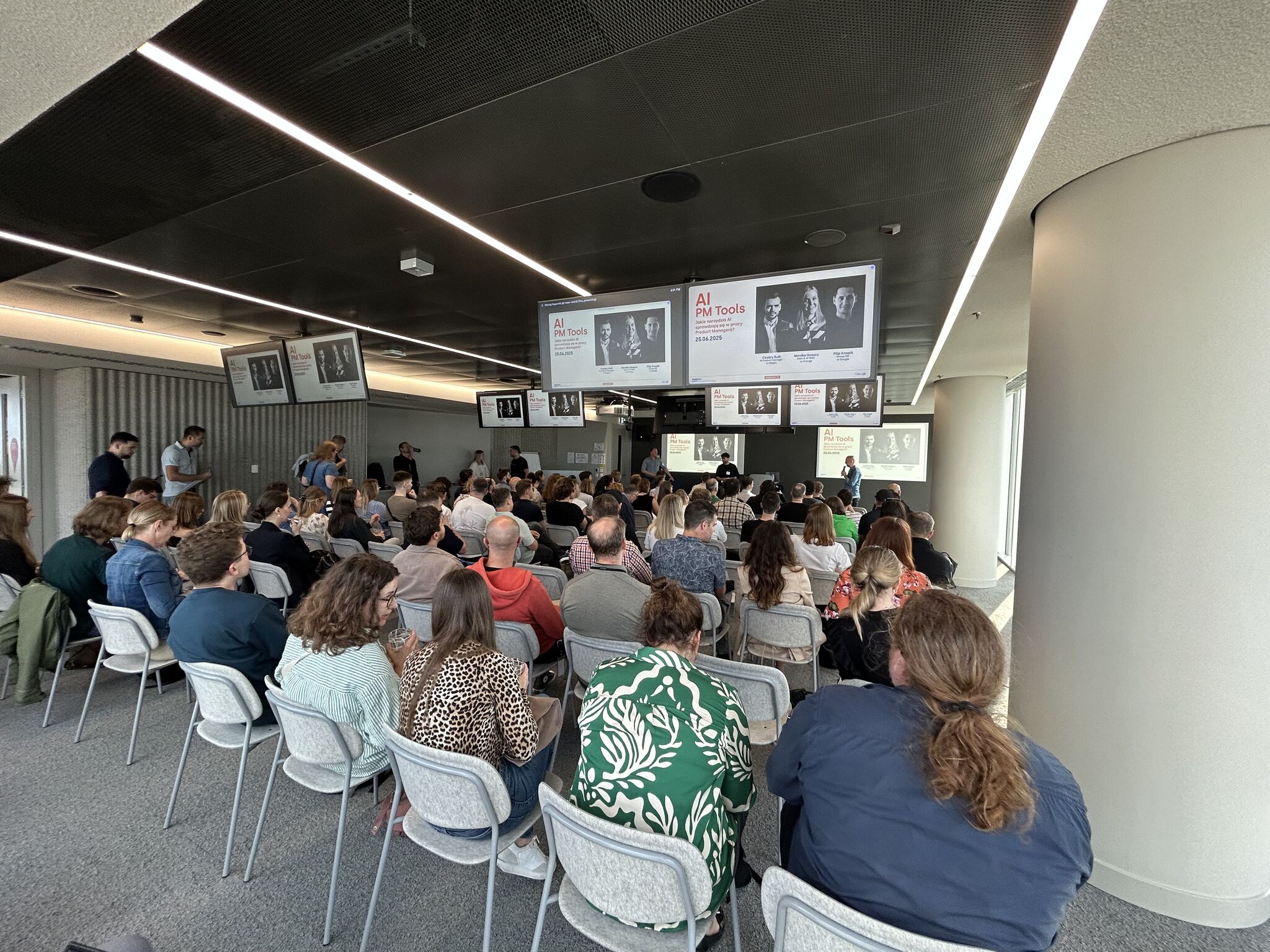
At the last Product Cafe Warsaw #13, entirely dedicated to AI tools for Product Managers, it was clear the topic strikes a nerve. Nearly 300 sign-ups and a room filled to capacity — a strong signal that AI has moved beyond hype into something that genuinely affects how PMs work every day.
In the hallway conversations, two very different voices emerged. Some PMs didn't hide their anxiety: "Will AI take our jobs?" In an era of mass layoffs and long job searches, that fear is understandable. On the other side, many of us were thrilled like kids with new toys — the ability to run market research quickly, generate prototypes, or automate routine tasks that used to eat up hours.
Fear of new technology is natural and well-documented throughout history. Think of medieval scribes who trembled at the sight of the printing press. In the end, Gutenberg's machine didn't just make books more accessible — it created entirely new professions: editors, printers, illustrators. No scribe back then could have imagined that someone would one day call themselves a "content designer" or a "UX writer."
In the age of AI, three skills become essential: agency, critical thinking, and creativity. These are what will allow us to collaborate effectively with AI tools rather than be replaced by them.
Personally, I've stopped chasing every AI trend. The industry moves so fast that tracking every new development has become impossible. I also agree with a view that's been gaining traction lately: even if language model development stopped today, we'd still have at least a decade of work ahead to fully leverage their current capabilities.
That said, I believe experimenting with AI tools is necessary. I've set aside a dedicated budget for this — to freely try new solutions and consciously decide which ones deserve a place in my toolkit.
While I believe a PM doesn't need a technical background, I do think a basic understanding of how models work is now essential. It's similar to studying psychology to better understand people — by learning the technical fundamentals of language models, we can better grasp what's happening "under the hood."
Consider the core PM competencies: customer empathy, strategic vision, communication, problem-solving, and user research. Each of these can be effectively supported by the right AI tools today. {ChatGPT} helps quickly analyze user feedback and generate new ideas, {Perplexity} delivers up-to-date market intelligence in seconds, {Replit} lets PMs build quick UI prototypes without involving engineers, NotebookLM helps analyze an ocean of information, {ElevenLabs} makes it easy to create narrations, and {Synthesia} produces polished video content.
I'm deliberately using the {} notation, which anyone who works with Python prompts will recognize. It means anything can go there — depending on context. This is my answer to the question I hear constantly: "Which AI tool is the best?" They're all great. We're living in the early-adopter era, where providers compete for us by offering the latest models for free. I don't know about you, but the free tier of most tools covers the majority of my needs. The real question isn't "which tool is best?" but "how do we use what we already have effectively?"
A few months ago, I attended a conference where a speaker demonstrated using Perplexity for market research and niche discovery. What impressed me wasn't the tool itself (deep search in Gemini or ChatGPT arguably works better) — it was how he used it: as a way to accelerate his own thinking process and achieve better results in less time. That was a powerful lesson. AI supported him, but the human delivered the real value.
At another conference, my eye — now trained to spot AI-generated content — immediately caught a presentation built in Gamma. I'll admit I'm not a fan of that tool, and I don't share the enthusiasm of people who "create an entire presentation with a single prompt." I've sat through a few such talks where the slides, not the speaker, drove the narrative — and it wasn't a great experience. During this particular workshop, someone in the audience asked: "Was this presentation made in Gamma?" "Yes!" the speaker confirmed. "I used to spend an entire night making slides. Now I feed my materials into Gamma, it builds the slides, and I have more time to focus on delivering as much value to you as possible." And it was true — the workshop was excellent. In this case, the speaker put the soul into the slides, not the other way around. AI didn't strip the presentation of its individuality. For me, this is a perfect example of how AI frees up time for our own creative work.
The more examples like this I see, the more I believe that AI won't replace PMs. PMs who know how to use AI will replace those who don't. But it's important to distinguish between work created with AI support, where a human sets the direction, and work entirely generated by AI. The first is genuine human-machine synergy. The second is like a winter strawberry — it looks the part but tastes like grass.
I believe the best products don't come from the most sophisticated tools but from clear ideas. A quick sketch on a napkin or a story told with passion beats even the most polished AI-generated presentation. But combining human creativity with AI's capacity for grunt work opens the door to new possibilities — unicorns built by small teams and remarkable products that are still ahead of us.
One last thing — this article was written with the help of AI. But AI didn't decide its shape. My emotions did, the ones I shared with you at Product Cafe. See you next season.
View more articles
Learn actionable strategies, proven workflows, and tips from experts to help your product thrive.