Tools
PMs in the Terminal
Last month I watched PMs open a terminal like it was Figma. That shouldn't feel normal. But it does now.
Why Product Managers Are Adopting Dev-Native Tools — and What It Signals About the Job
Last month, at an AI product meetup, I watched something that would have been unthinkable eighteen months ago. Product managers — not engineers, not former developers, not "technical PMs" — opened terminal windows, ran agents, reviewed artifacts, and iterated on working prototypes. Nobody flinched. Nobody asked permission from engineering. The terminal had become their workspace.
That image stayed with me. Not because the tools are new — Claude Code, Cursor, Gemini CLI, Google Antigravity have all been available for months. But because the behavior reveals something deeper about how the PM role is shifting underneath us.
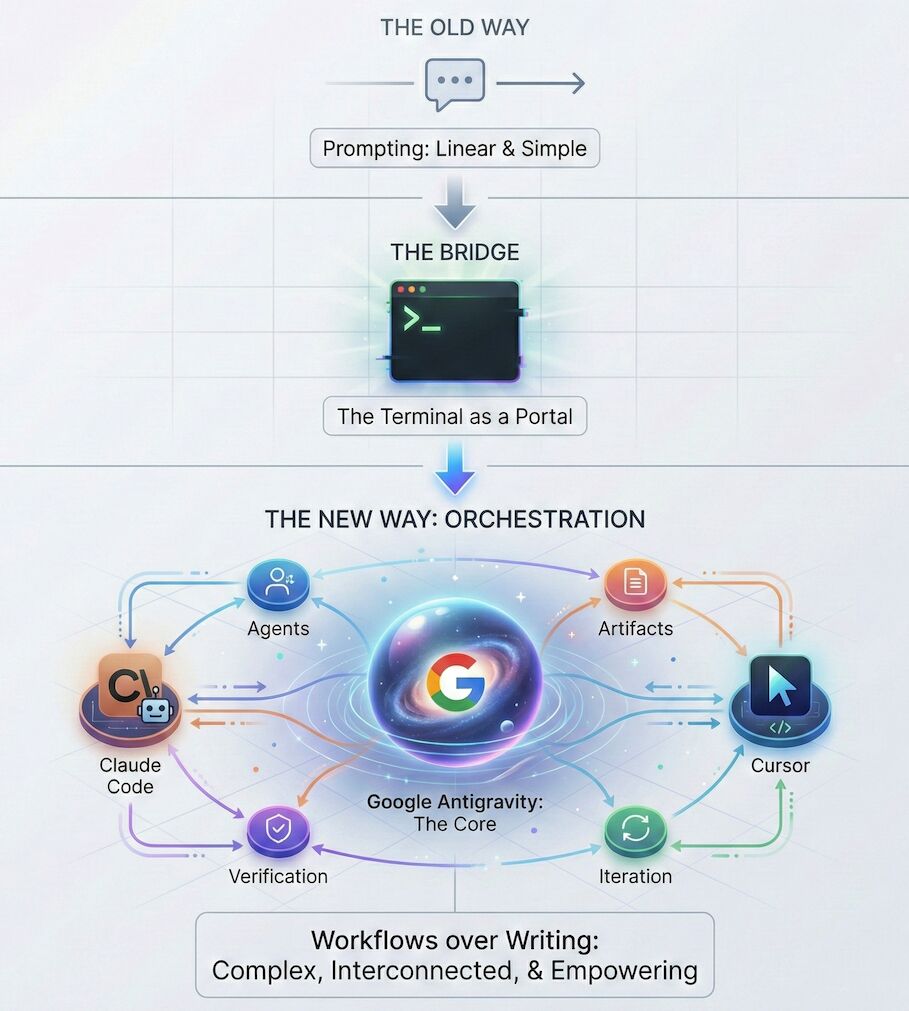
The shift isn't about prompting. It's about orchestration.
The Job Changed Before the Job Description Did
Product management has always involved breaking ambiguous problems into actionable work, coordinating across teams, and evaluating outcomes. What's changed is the execution surface.
Anthropic's 2026 Agentic Coding Trends Report frames it precisely: software development is shifting from writing code to orchestrating agents that write code. Agents handle implementation, testing, debugging, and documentation. Humans focus on architecture, direction, and judgment. The report identifies this not as a future prediction but as an observable trend across engineering teams at companies like Rakuten, CRED, and Zapier.
Now extend that observation beyond engineering. If orchestrating agents is the new implementation layer, and PMs already specialize in breaking work into tasks, defining requirements, reviewing outputs, and iterating — then the skills are the same. The surface is different.
That's why agentic coding tools suddenly feel PM-native. They don't just help you write. They let you run a workflow.
A PM at Maven's Claude Code course described the shift this way: moving from "I use ChatGPT to ask questions for work" to "I use coding agents to brainstorm, build, and test new product features." That's not a prompt upgrade. That's a role expansion.
The Tools and Who's Winning
The agentic tool landscape is crowded and moving fast. But three tools keep surfacing in PM conversations, each with a different design philosophy.
Claude Code is winning mindshare among PMs who go deep. Not because it's easy — it runs in a terminal and requires some comfort with command-line basics. But because it behaves like a strong teammate: it plans, executes, self-corrects, and explains its reasoning. The numbers back the enthusiasm. Claude Code reached $1 billion in annualized revenue within six months of its public launch in May 2025. By February 2026, that figure had crossed $2.5 billion — doubling since the start of the year. A UC San Diego and Cornell University survey of 99 professional developers found Claude Code among the three most widely adopted coding platforms, alongside GitHub Copilot and Cursor. Bloomberg reported that average users now spend 20 hours per week working with the product. PMs are building prototypes, automating competitive analysis, generating PRDs from meeting notes, and spinning up internal tools — all without writing a single line of code themselves.
Cursor took a different path. It's a standalone IDE, forked from Visual Studio Code, rebuilt specifically for AI-assisted development. The product hit $1 billion in annualized revenue in under 24 months — the fastest in B2B SaaS history — and secured a $29.3 billion valuation. Its Composer feature lets you describe a task and then watch the agent plan and execute changes across every affected file simultaneously. Cursor can run up to eight agents in parallel, each in its own copy of the codebase. For PMs who want a visual environment rather than a terminal, Cursor offers the closest thing to an AI-powered Figma for code. The trade-off: it's optimized for developers, and the learning curve for non-technical users is steeper than Claude Code's natural language approach.
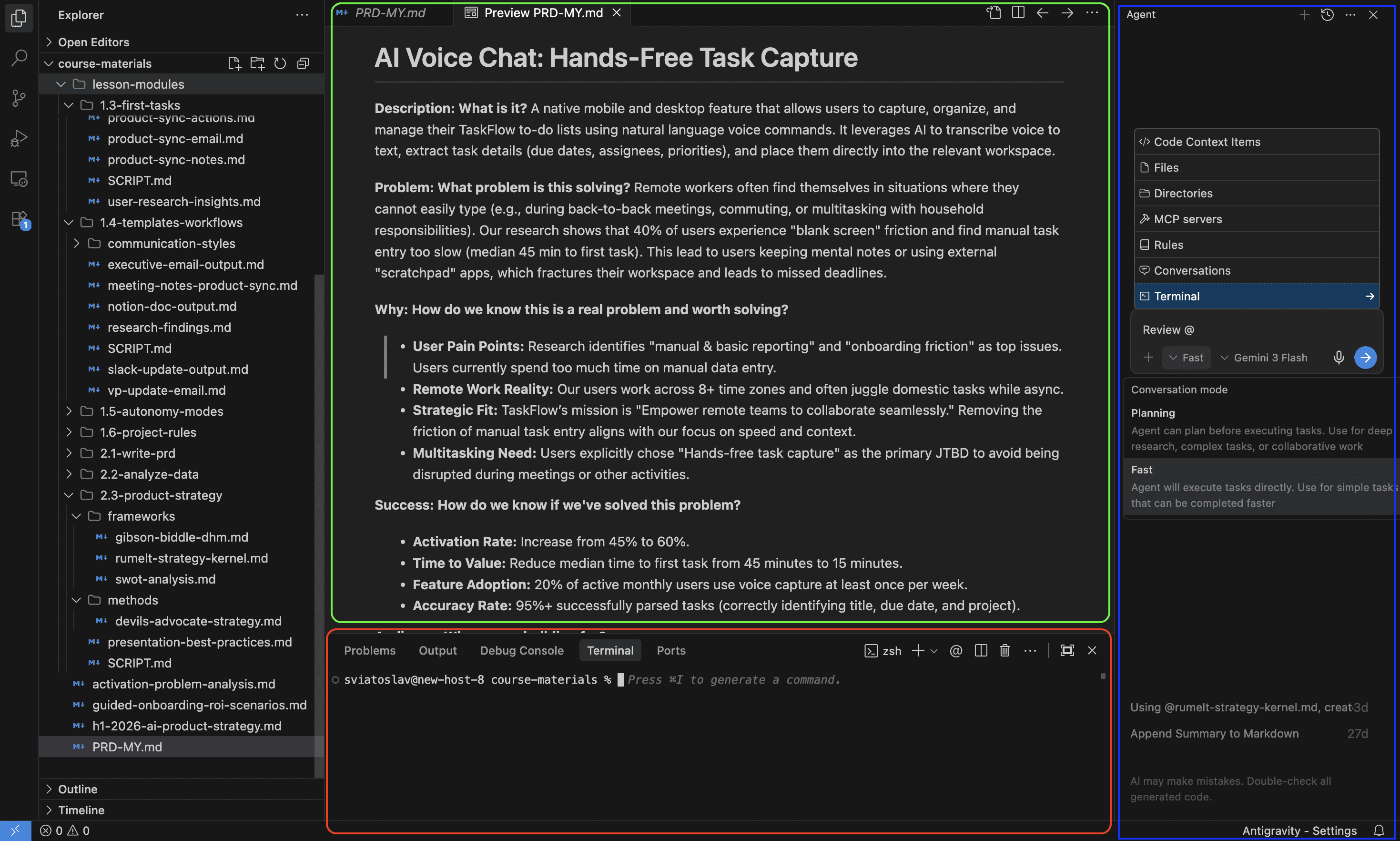
Google Antigravity launched in November 2025 and takes the most architecturally ambitious approach. Built on a VS Code fork by the Windsurf team that Google acquired for $2.4 billion, Antigravity is designed around what it calls an "agent-first" philosophy. It offers two modes: an Editor View for hands-on coding, and a Manager View for orchestrating multiple agents working in parallel. What sets it apart is its emphasis on verification. Agents generate Artifacts — task lists, implementation plans, screenshots, browser recordings — that serve as tangible proof of work rather than raw tool calls. You can leave feedback directly on an Artifact, and the agent incorporates your input without stopping execution. The platform also includes a browser sub-agent that can visually verify UI changes using Gemini 3's multimodal capabilities. For PMs, the Manager View is the key: it treats development as a supervision task, not a typing task.
After spending time with each tool, I'm placing my bet on Antigravity. Not because it's the most polished — it launched only months ago and early users report inconsistencies. But because it's built around the right primitives: agents, artifacts, and verification. Those are the same primitives PMs already think in.
Anthropic Sees the Non-Technical Pull
Anthropic clearly recognizes that Claude Code's audience extends far beyond developers. The company observed that users were repurposing Claude Code for non-coding tasks — vacation planning, spreadsheet work, file organization — and rather than restricting the behavior, they shipped a dedicated product.
On January 12, 2026, Anthropic launched Claude Cowork — described internally as "Claude Code for the rest of your work." Built on the same Claude Agent SDK, Cowork lets non-technical users point Claude at a folder and delegate autonomous file management through a chat interface. The team built the entire product in approximately ten days, largely using Claude Code itself. Boris Cherny, head of Claude Code, explained the logic: developers had already shown what agentic workflows could do. Cowork was about making that power accessible to everyone else.
The response validated the move. Simon Willison called it "genuinely good — quietly devastating good." VentureBeat described it as a shift from "Copy-Paste AI" to "Execution AI." Within weeks, the Cowork launch — combined with Claude Code's momentum — contributed to a significant selloff in SaaS stocks, as investors recognized that general-purpose AI agents could displace dozens of single-purpose productivity tools.
Anthropic followed up with plug-ins for Cowork, designed to automate specialized tasks across departments — marketing, legal, customer support, sales. The company open-sourced eleven plug-ins and positioned the system for enterprise customization. The strategy is bottom-up: build a powerful developer tool, prove it works, then abstract the capabilities for broader audiences.
For PMs, this matters because Cowork is the bridge between "I'm curious about agentic tools" and "I'm running workflows." It lowers the barrier without lowering the capability.
The Uncomfortable Truth About This Category
Here's what most tool comparisons won't say: these products are only as good as the models behind them.
Claude Code's advantage today isn't primarily the terminal interface or the MCP integrations. It's that Claude Opus 4.6 reasons well across long-running, multi-step workflows. Cursor's strength with Composer depends on whichever frontier model it's routing to. Antigravity's promise rests on Gemini 3's multimodal capabilities and its support for multiple model providers.
Models improve in discontinuous leaps, not gradual curves. When the next generation of models lands — better reasoning, longer context, more reliable tool use — the agentic tools built to absorb those improvements will pull ahead. The ones patched around current model limitations will struggle to keep up.
This is why Antigravity's architecture feels right to me. It supports Gemini 3 Pro, Claude Sonnet 4.5, Claude Opus 4.5, and OpenAI models. It doesn't lock you into one model provider. It treats the model as a component, not a foundation. And its artifact-based verification system works regardless of which model generated the code. The winners in this category will be the platforms designed to evolve with model leaps, not the ones designed around one model's current strengths.
Cursor understood this early. As CEO Michael Truell explained, the company's approach is to cherry-pick the best models available, supplement them with proprietary ones where necessary, and wrap everything into a superior interface. That model-agnostic philosophy is a significant part of why they're valued at $29.3 billion.
The open question is whether the model providers themselves will capture the tool layer. Anthropic already has Claude Code and Cowork. Google has Antigravity, Gemini CLI, and Jules. OpenAI acquired Windsurf for $3 billion. When OpenAI tried and failed to acquire Cursor, it signaled that even the largest AI lab recognized it couldn't easily replicate what a dedicated tool company had built. But the competitive pressure is real, and it's intensifying.
What This Actually Means for PMs
The PM community is responding to this shift faster than most corporate learning programs can track. There are now dedicated courses — Maven offers a Claude Code course specifically for product managers. Carl Vellotti built a free interactive tutorial that teaches Claude Code from a PM perspective. Substack newsletters are publishing Claude Code plug-in systems designed specifically for product workflows — competitive analysis, PRD generation, data exploration, user research synthesis.
This isn't a niche hobby. Anthropic's own Dario Amodei noted at Davos that even engineers within Anthropic have stopped writing code, instead letting models write code and focusing on editing and direction. If that's happening inside the company building the models, the pattern will reach product teams everywhere.
But the adoption comes with a tension that one PM captured well after her experience building with Cursor and Claude: "My ideas translated into working code in minutes, and changes were a conversation away. This made me feel like a 10x engineer — until things broke. Then I remembered: I'm still a PM, just wielding new tools." That tension — between empowerment and overwhelm — is where the real skill gap lives.
The PMs who thrive won't be the ones who learn to write the best prompts. They'll be the ones who learn to orchestrate: breaking work into well-scoped tasks, running agents against those tasks, reviewing artifacts critically, iterating on outcomes, and knowing when to trust the output versus when to dig deeper. That's not a new skillset. It's the PM skillset applied to a new surface.
Resources That Pushed Me Deeper
The community producing educational content around these tools is growing fast. Here's what inspired my own exploration.
Videos for inspiration:
Claude Cowork by Boris Cherny — the product lead walks through the vision and architecture
Claude Code by Zevi Arnovitz — practical PM-focused workflow demonstrations
Google Antigravity by Kevin Hou — hands-on walkthrough of the Manager View and Artifacts
Learning materials:
Google Antigravity course by Carl Vellotti — the most comprehensive PM-oriented guide I've found
Google Antigravity deep dive by Julian Goldie — technical walkthrough with practical examples
Gemini CLI by Dariusz Mozgowoj — the best Polish-language resource, with a free module to try
The Real Question
The agentic tool market is a $2.5 billion+ category that barely existed eighteen months ago. Claude Code alone generates more revenue than most enterprise SaaS companies. Cursor hit $1 billion in ARR faster than any B2B product in history. Google committed $2.4 billion to acquire the Windsurf team and build Antigravity. The capital flowing into this space is not speculative — it's tracking measurable productivity gains in production environments.
PMs who wait for these tools to be officially sanctioned by their organizations will find themselves learning what their peers already know. PMs who experiment now — even imperfectly, even with the terminal feeling foreign — are building the orchestration muscle that this job is going to require.
The terminal isn't replacing Figma. But it's sitting right next to it.
Is this future something you fear — or something you're building toward?
View more articles
Learn actionable strategies, proven workflows, and tips from experts to help your product thrive.