Events
The Great Tech Paradox of 2026:
This post explores the modern "tech paradox" where AI and cloud tools have effectively erased the technical barriers to building software, shifting the competitive advantage from product velocity to delivering undeniable, end-to-end business outcomes. To win in this new era, startups must rely on small, highly-leveraged teams to solve hard market uncertainties rather than just shipping features.
The Great Tech Paradox of 2026: Why Building Fast is No Longer Enough
We are entering a paradoxical era in the tech industry: Infinite product velocity, but finite user attention.
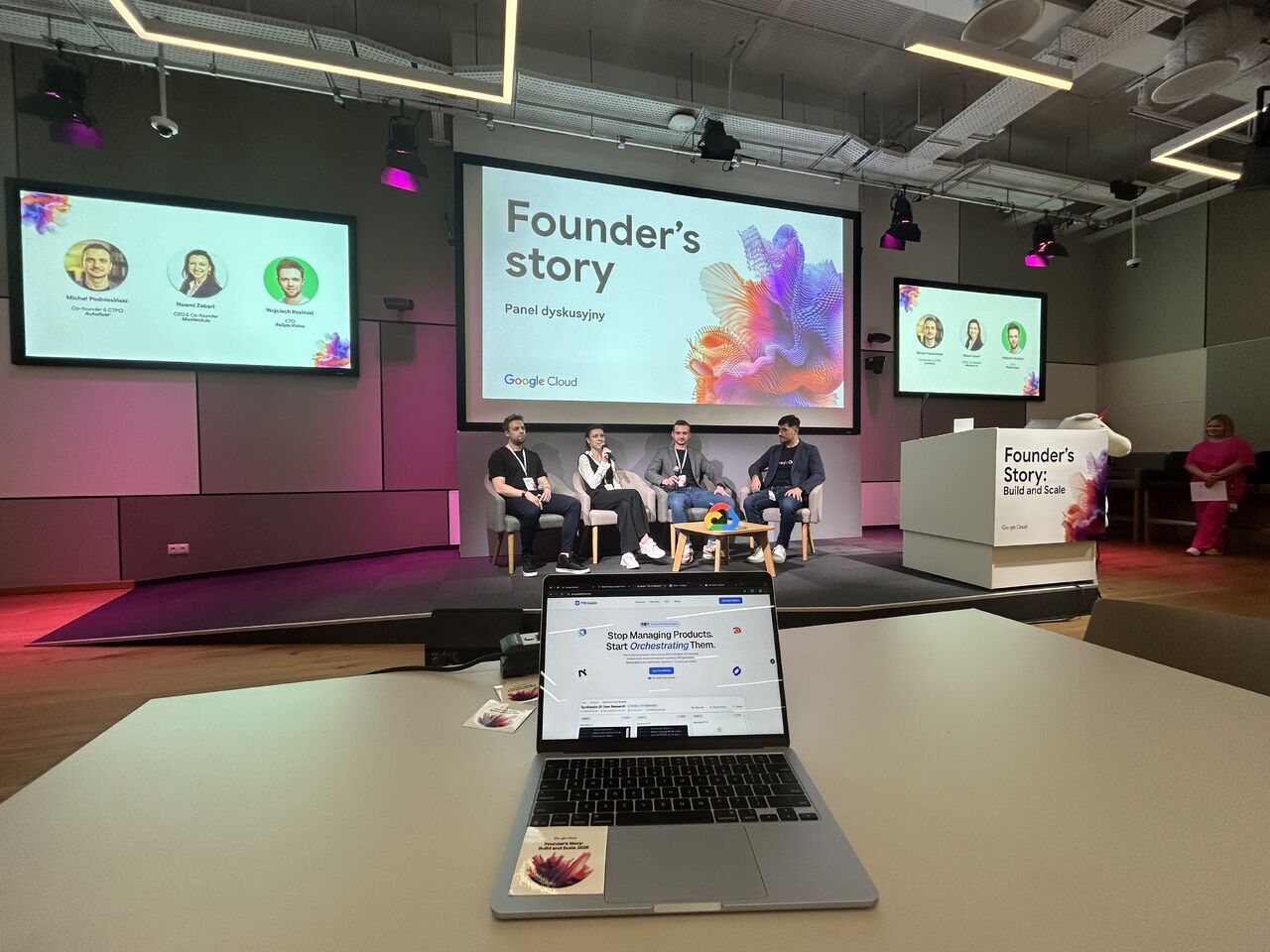
Recently, I attended Founder’s Story: Build and Scale 2026 at the Google for Startups Campus in Warsaw. The sessions, panels, and hands-on workshops helped crystallize a massive shift I’ve been observing for some time in how startups are actually built today—and more importantly, how they win.
Cloud platforms and generative AI have effectively erased the technical barrier to entry. Today, a focused team—sometimes just a handful of people—can ship a Minimum Viable Product (MVP) or a working AI agent in a matter of days.
But there is a catch. When everyone can build fast, building is no longer your competitive advantage. Signal, distribution, trust, and measurable outcomes have become the new battlegrounds.
Here is a deep dive into how the startup game is evolving in 2026, straight from the trenches of Google Cloud and some of the region's top founders.
1. The Great Tech Paradox
Speaker Insight: Michał Kramarz (Head of Incubation & Acceleration CEE, Google Cloud)
Michał Kramarz opened the morning by framing the exact paradox we are living in. While tools like Google Cloud and advanced GenAI have almost completely dismantled the barrier to entry, the barrier to market success has drastically increased.
We are living in a hyper-competitive era. The market is flooded with "good enough" software. To win today, founders must evolve from merely building software to delivering undeniable, measurable results.
From SaaS Features to "Outcome as a Service"
A powerful analogy emerged during the sessions that perfectly encapsulates this shift:
A robot mower cuts the grass.
A gardener ensures the lawn is always green.
AI products that only automate a fragment of a workflow will struggle to retain users. Winning startups are designing for end-to-end value. They don't just sell a tool; they sell the outcome.
The Old Playbook (2010s) | The New Playbook (2026) |
Focus on feature roadmaps | Focus on agentic workflows |
Sell software licenses | Sell guaranteed business outcomes |
Massive engineering teams | Highly leveraged, AI-native pods |
Polish the UI first | Validate the core technical risk first |
2. The New "Unicorn Math"
Speaker Insight: Axel Täubert & Michael Dietz (Google Cloud)
Scaling a company to unicorn status no longer requires hundreds of engineers and a decade-long roadmap. In their session, Axel and Michael broke down the new math of scaling: Building your startup in half the time with a quarter of the people.
AI-native startups are reaching global traction with highly leveraged teams. This fundamentally changes the role of the founder. You are no longer just a roadmap owner or a manager of vast engineering departments; you are an orchestrator of systems, talent, and AI capabilities.
3. Real Talk: Solving the Hardest Uncertainty First
Speaker Insight: Founder's Panel (Dawid Szymula, Michał Podniesiński of Autofixer, Noemi Zabari of Muotech.io, Wojciech Rosiński of ReSpo.Vision)
The Founder’s Story panel provided an unfiltered look at scaling in the AI era. The overwhelming consensus? Solve the hardest uncertainty first.
In a world where you can generate UI code in seconds, polishing interfaces or expanding your product's scope before proving your core breakthrough is just expensive theatre. Founders must ruthlessly validate their core technical or market risks early. If the fundamental AI model or the core value proposition doesn't work, no amount of frontend polish will save it.
4. Agentic Workflows are the New Infrastructure
Speaker Insight: Omar Sanseviero (DeepMind), Łukasz Olejniczak (Google Cloud)
We have moved past simple text-in, text-out chatbots. The presentation by Omar Sanseviero on the Google DeepMind stack (covering Gemini, Veo, and the Gemma open models) highlighted the sheer power available to developers today.
But the real magic happened when theory met practice. Łukasz Olejniczak demonstrated how to build an MVP of an intelligent, voice-activated AI agent in just 30 minutes using Gemini Enterprise for Customer Experience.
This wasn't a toy. It was an agent you could call directly from a phone, grounded in specialized knowledge via Vertex AI Search, and connected to real-time business systems using MCP (Model Context Protocol).
This compresses iteration cycles incredibly. When multi-step AI workflows, voice agents, and multimodal prototypes can move from idea to execution this quickly, the bar for differentiation skyrockets.
5. From Idea to Execution: The ADK Agent
Speaker Insight: Workshop with Kasia Siedlarek & Zuza Bochenek (Google Cloud)
The afternoon was entirely hands-on. Instead of listening to theory, we used the Google Cloud console to build our own agents.
A massive thanks to Kasia Siedlarek for helping me navigate the technical hurdles while launching the ADK agent. Seeing a concept transform into a working prototype under the guidance of Google engineers is a visceral reminder of the speed at which we can operate today.
Poland as a Global Launchpad
Joanna Kowal kicked off the day by reminding us of the unique position we are in. Poland is stepping onto the global economic stage with unprecedented force.
With access to the exact same AI models and cloud infrastructure as Silicon Valley—often operating at a leaner, more efficient cost base—local startups are no longer building for the domestic market. They are building global products from day one.
View more articles
Learn actionable strategies, proven workflows, and tips from experts to help your product thrive.