Events
The Solopreneur’s Leverage
AI has made building products faster and cheaper than ever—but speed without distribution and judgment leads to wasted effort. The real edge today isn’t shipping more, but knowing what not to build and focusing only on what drives lasting value.
The Solopreneur’s Leverage (and the Builder’s Trap)
We’ve entered a new phase of entrepreneurship—one where solo founders and tiny teams can profitably serve hyper-specific niches that would have been economically irrational just a few years ago.
The reason is simple: generative AI has collapsed the distance between idea and execution. What once required a team of engineers, designers, and weeks of iteration can now be achieved by a single person in days—or even hours. The path from concept → prototype → usable workflow has never been shorter.
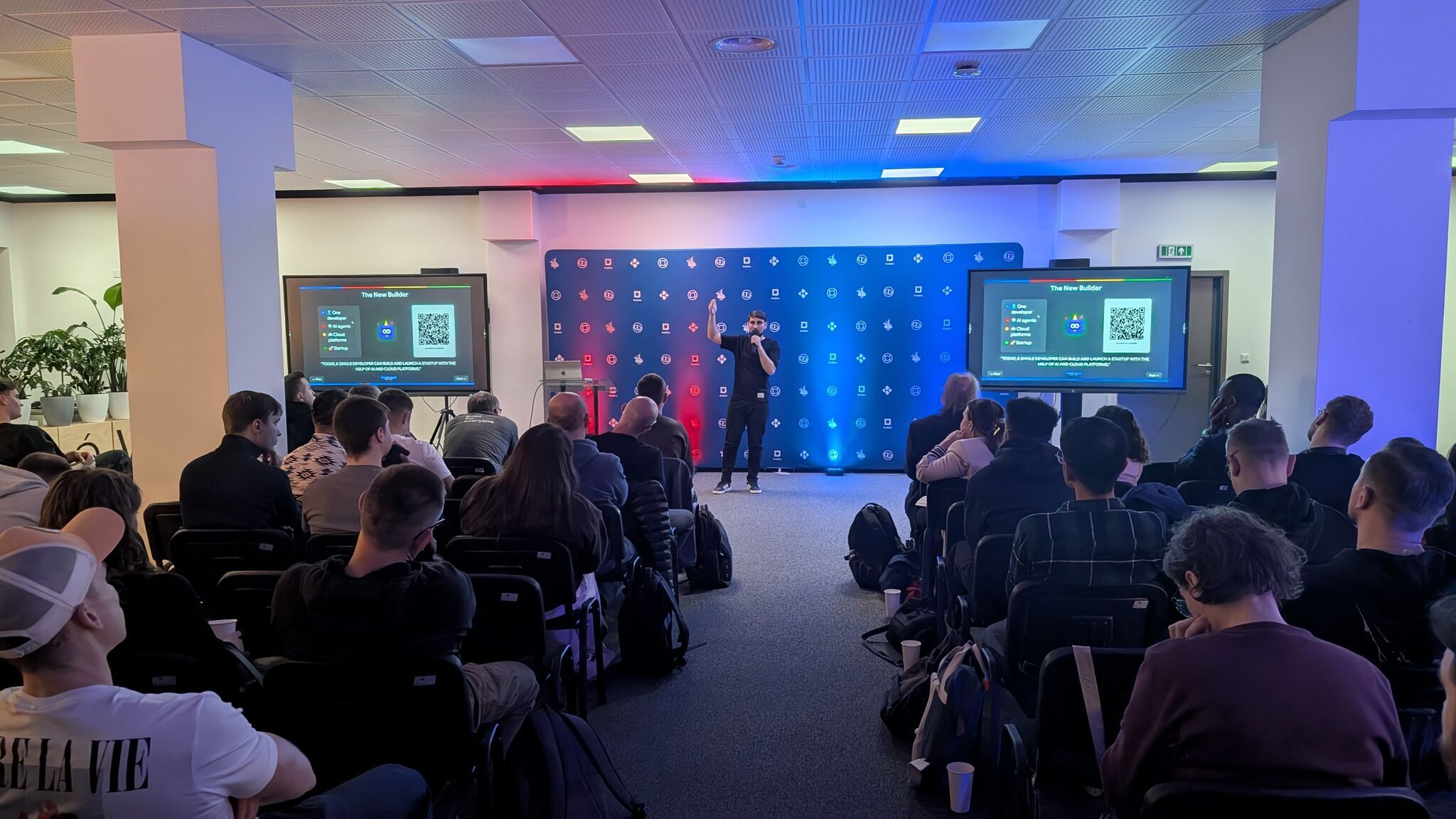
At a recent event, Mehmet Ali Ustaoglu illustrated this shift through his journey building Ludigen. His experience made one thing clear: AI is no longer just an assistant—it’s a force multiplier. It enables rapid prototyping, scalable content generation, and the ability to test ideas at a pace that was previously unimaginable.
But this leverage comes with a hidden cost.
The same tools that accelerate building also make it dangerously easy to overbuild. Today, a solo founder can ship a surprisingly complex MVP over a weekend. Yet without a clear distribution strategy, that speed doesn’t translate into traction—it simply compounds into wasted effort.
This is the modern builder’s trap: confusing the ability to build with the ability to create value.
The core takeaway:
AI drastically reduces the need for large teams—but it does nothing to reduce the need for sharp, disciplined product judgment.
The New Laws of Startup Physics
When the cost of production collapses, the rules of the game change. We’re now operating under a new set of startup “physics”:
1. Build Speed Is Abundant; Attention Is Scarce
The market is increasingly saturated with tools, apps, and AI-powered features. If your only advantage is speed, you have no advantage at all. Distribution—not development—is now the bottleneck.
2. Prototype Quality Outpaces Problem Validation
It’s easier than ever to build something polished, functional, and impressive. But that doesn’t mean anyone actually needs it. The danger is falling in love with execution before validating demand.
3. Niches Are Viable—But Only With Clear Acquisition Loops
AI makes it economically feasible to target extremely narrow user segments. However, niche viability depends entirely on whether you can reliably reach those users. If you don’t know where they are—or how to acquire them cheaply—the business fails.
4. Distribution Must Precede Depth
The old model was: build first, figure out distribution later.
That model is now obsolete.
Today, if you don’t have a clear distribution wedge before writing your first line of code, you’re already behind. The best founders design acquisition into the product from day one.
Preparing for Radically Cheaper Intelligence
To understand where this is heading, we need to look at the underlying mechanics of modern AI.
At the same event, Christian Merkwirth offered a stripped-down explanation of Transformers—the architecture behind large language models. His key insight: by predicting the next word at scale, these systems uncover patterns that resemble reasoning.
This seemingly simple mechanism has unlocked capabilities that are rapidly improving—and becoming cheaper.
Drawing on his experience at companies like Nvidia and Google, Christian emphasized a critical point:
We are heading toward a world where high-level intelligence becomes abundant and commoditized.
This raises a fundamental question for founders:
If intelligence becomes cheap, where does your advantage come from?
The answer lies in what sits above the model.
Verification: Ensuring outputs are accurate and reliable
Trust: Building confidence that the system works consistently
Workflow integration: Embedding AI into real user behavior
Outcome ownership: Delivering results, not just responses
In this new paradigm, the model is not the product—it’s infrastructure.
The real value shifts to the layer that guarantees that the AI actually works in practice.
The Next Edge: Learning What Not to Build
When experimentation becomes cheap, discipline becomes everything.
The modern founder can test more ideas in a month than was previously possible in a year. But without strict constraints, this leads to noise—not progress.
Cheap experiments demand clear, predefined kill criteria.
If a feature or product doesn’t hit a specific metric within a defined timeframe—days, not months—it should be shut down. Not iterated endlessly. Not “given more time.” Killed.
Because the real cost is no longer building—it’s attention and focus.
We’ve already maximized build speed. Code generation is no longer the bottleneck.
The new competitive edge is faster learning what not to build.
The Hardest Question in Modern Product Building
This leads to the most difficult decision founders now face:
When an AI product shows strong early traction—but weak long-term retention—what is the one signal that forces you to stop?
A useful lens:
If users engage once but don’t return, you likely solved a curiosity, not a problem
If usage doesn’t become part of a workflow, it won’t persist
If the product doesn’t create ongoing value, it will be replaced or forgotten
The clearest “stop” signal:
When usage fails to convert into repeat behavior tied to a real user workflow—despite multiple iterations.
At that point, more tweaking won’t fix the problem. The issue isn’t the implementation—it’s the premise.
Closing Thought
AI has given founders unprecedented leverage.
But leverage amplifies both good decisions and bad ones.
The winners in this new era won’t be the fastest builders.
They’ll be the ones with the discipline to:
Choose the right problems
Design distribution early
Kill ideas quickly
And focus relentlessly on what actually matters
Because in a world where anything can be built—judgment becomes the only true moat.
View more articles
Learn actionable strategies, proven workflows, and tips from experts to help your product thrive.